Archive for the ‘Electronics’ Category

Tesla Article 1934

March 1, 2014

I actually own a copy of the magazine Modern Mechanix and Invention, July 1934. This great magazine has the article that has been many times around the internet but as a poor resolution scan. I have rescanned these 6 pages so you can enjoy them as clear copies. I did these a while ago, so excuse the misalignments, also the paper is yellowing and the spine is raggedy. Please enjoy, regards Arto.

MMXcover1a

This is the PDF file if you want to download it : ModernMech-1934-Tesla

Magic Square Coil Technology

June 5, 2013

I have decided to make a new blog rather than updating an older one, refer to https://artojh.wordpress.com/2012/08/24/multi-filar-coils/. I would like to thank Andy, he  has prompted me to finish my chapter on coil geometry, with a new heading of Magic Square Coil Form. Back in 1996 I was working hard on winding many stator coils for the Robert Adams pulse motor designs, when I realized the few coils I wound in bifilar geometries seem to function with non linear results. This is when I discovered the varieties of subtle refinements that could be engineered into a basic system, that can give  measurable increments of control over the energy storage of the coil while it is pulsed.

Estored =1/2 * L* I^2 = Energy in Joules stored in the Inductance

Estored = 1/2 * C * V^2 = Energy in Joules stored in the Capacitance

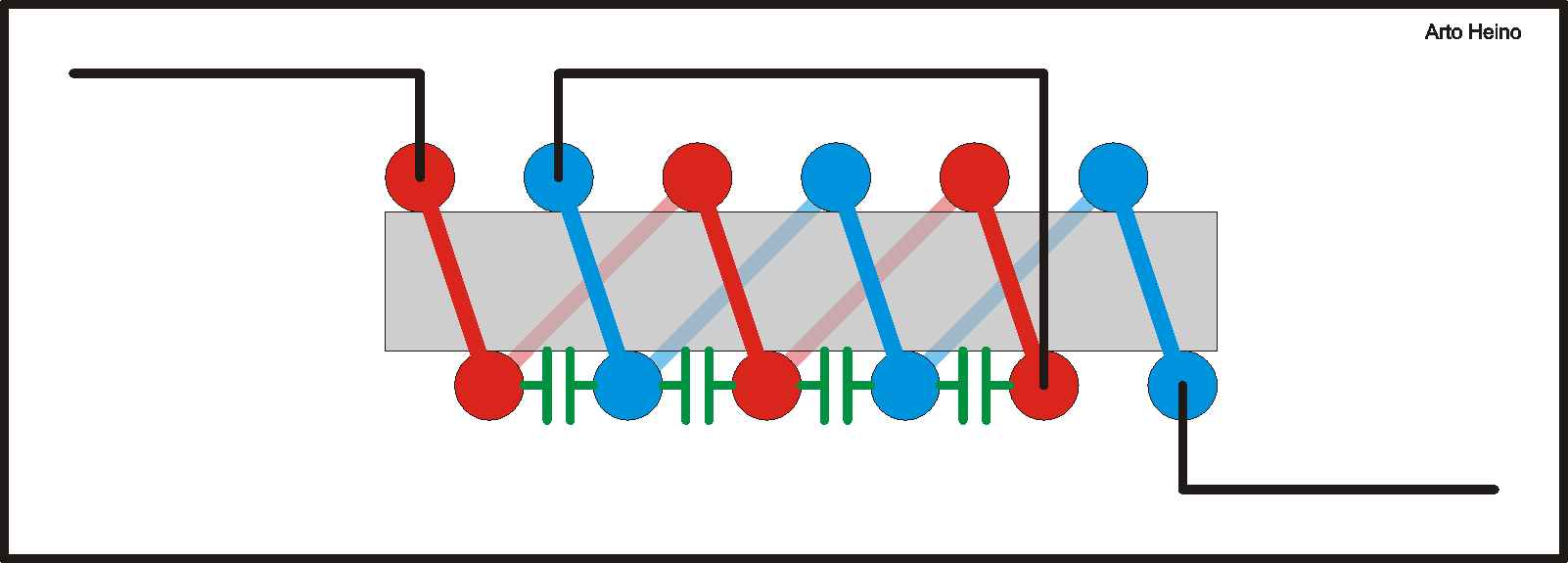
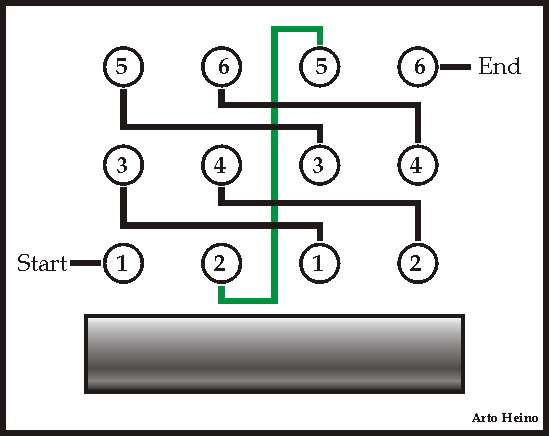
I chose the Magic Square of Four as the prototype for the coils design, refer to the first diagram that reveals my logic in a simplified form. The left stator coil is the left half of the Magic Square, this is how magic squares work mirror reflections that balance the numeric relationships to create harmony, where the wiring is now the pathways that have both Inductance and Capacitance is the same internal geometry as  a magic square, the right stator is now the right side of the magic square.

AdamsCoilsc3

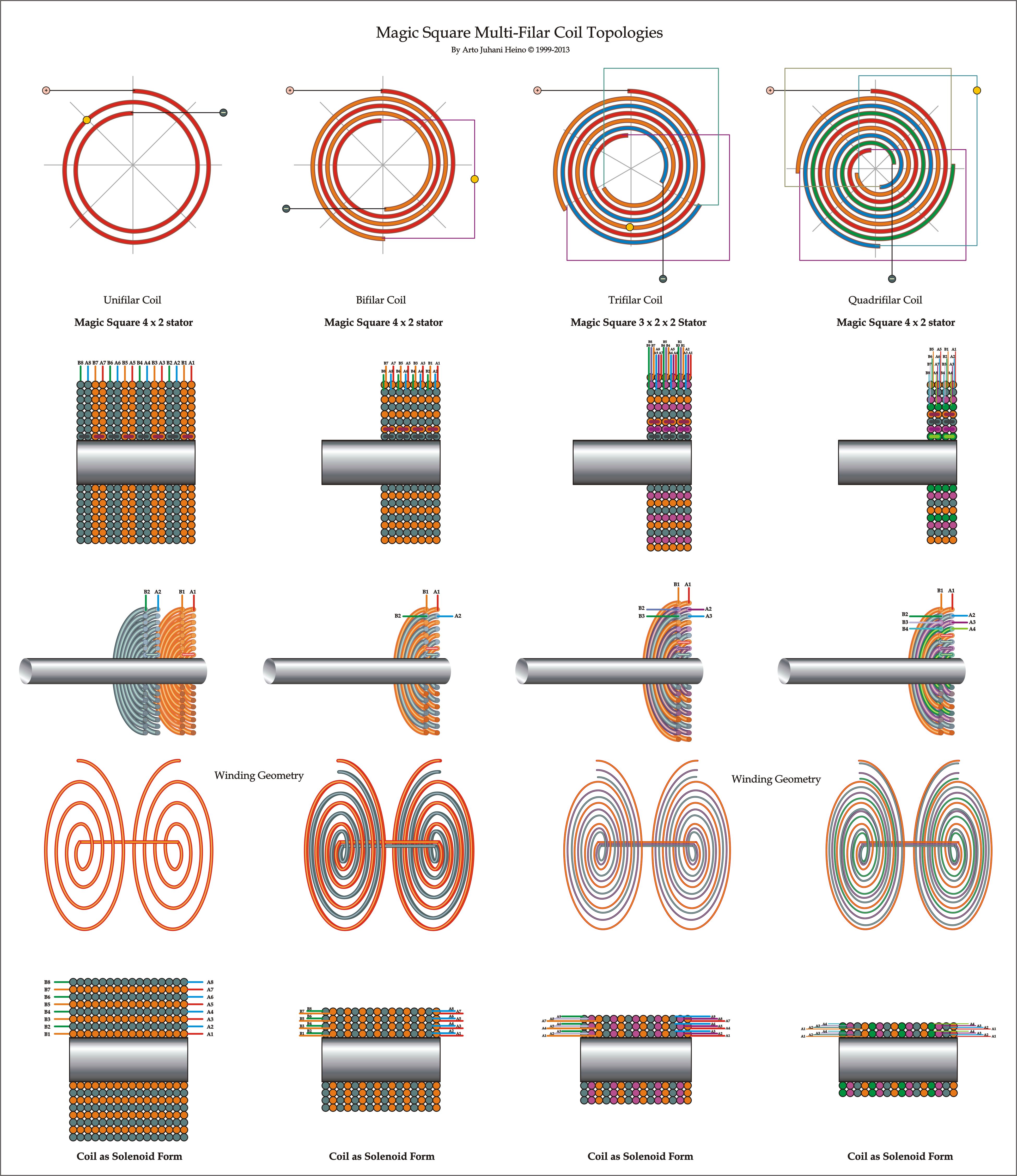
To understand the significance of creating chaotic systems that the outcomes  cannot be easily predicted, is to look into the heart of a living organism. The number of square four arrangements  available to the constructor becomes 880  basic Magic Square Four patterns.  If you expand the system you could have 4 coils each with a complete magic square arrangement giving you millions of 880 combinations. The design parameters can be expanded to include odd squares and  very large magic squares. The coils could also be split into the columns and rows giving you say 5 coils each with a in 5 and out 5 winding scheme, this will give you 25 separate wires that give you a square 5 arrangement.

The main criteria for any success is to keep all wires coming from the stators the same length and short as possible, a circuit board design would keep any stray Inductance and Capacitance to a minimum. A small circuit board could be at both ends of the stator with holes matching the wire ends and another attached between the stators, where you could mount a patch board or a special wire coil arrangement that Andy suggested. The environmental energy that exists in a chaotic form surrounds every object, a tumult of electrostatic, EM radiation , heat, dielectric charge fields and magnetism, this energy is not available to be absorbed into the circuit unless we can create a couple to its random behavior, and make a gate so the circuit can make use of it. This is the basis of a natural system based on natures gift to humanity Magic Squares, they are but discoveries of a natural system of numbers that can be translated in many different ways. The chaotic nature of magic squares gives you the invisible harmonic coupling  that needs to exist in a cyclic  system of energy exchange, the gating can now be engineered in the form of magic squares.

Here are the latest additions to help those who want to explore unknown territory. Regards Arto

AdamsCoilsd4

This next diagram should help you expand the possibilities of the simple methods I have inaugurated .

MultiFilarFlatCoilMagic1I will update this blog with any new information and tests. Regards Arto


Tesla Receiving Circuit

April 3, 2013

This file is only available as a PDF, please consider a donation via PayPal Regards Arto.

TeslaRecieverCircuit1a

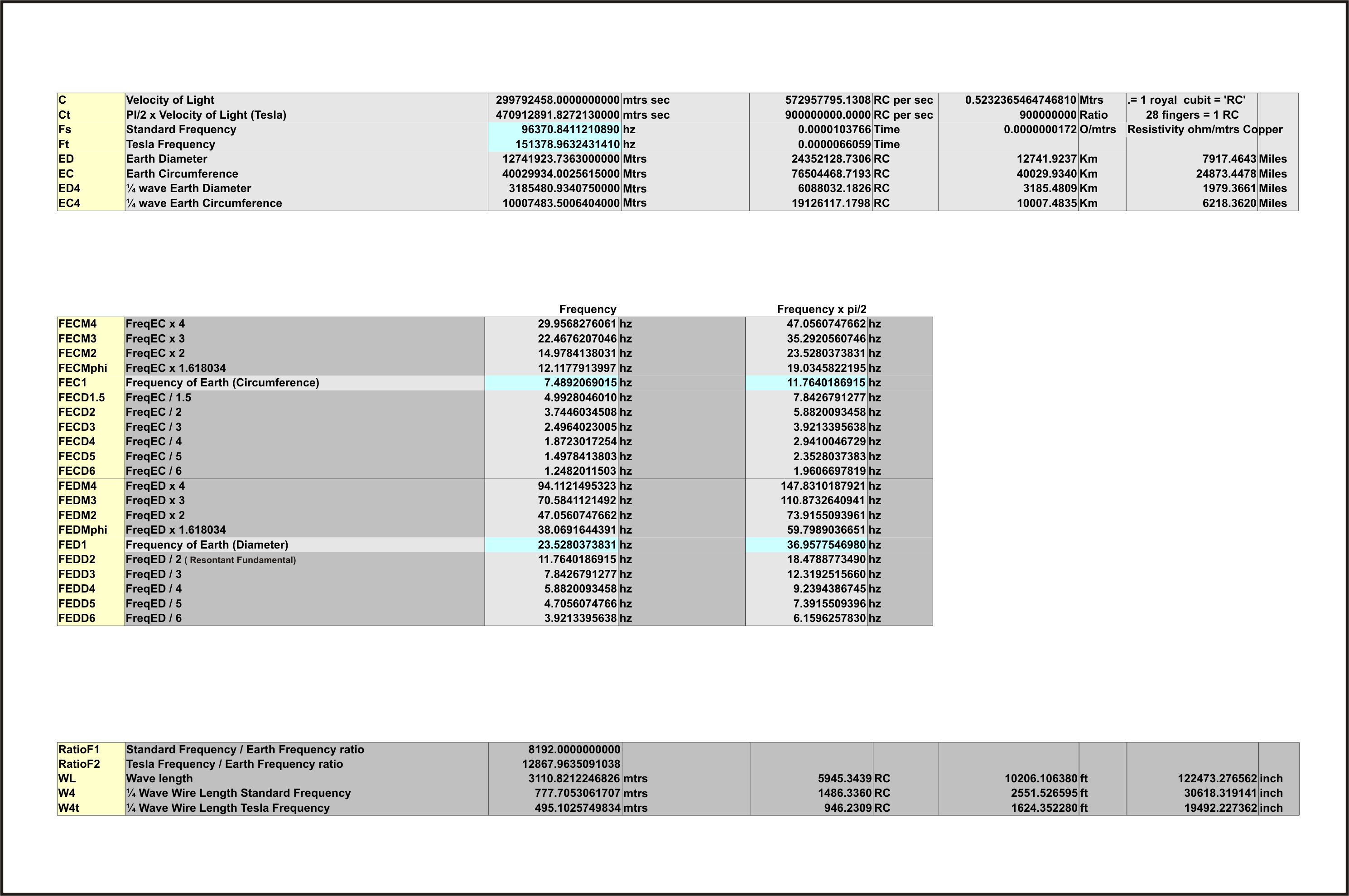
Earth as a Half Wave Resonator

March 18, 2013

This file is only available if you donate, please help a talented artist and  electrical investigator by donating $1.00 to support the work he produces. Contact me for the PDF file.

Regards Arto.

Quad Radiation Converter

March 15, 2013

Here is a fun project that will give you about 0.5/0.6/1.58 volts of radiation energy reception. The analogy is like a putting a microphone in a noisey environment and converting the noise into energy, either to recharge a battery or light a led. Some people call this a free energy receiver and they would be wrong in that assuption as the cost was in the original source radiation.

QuadRadio5

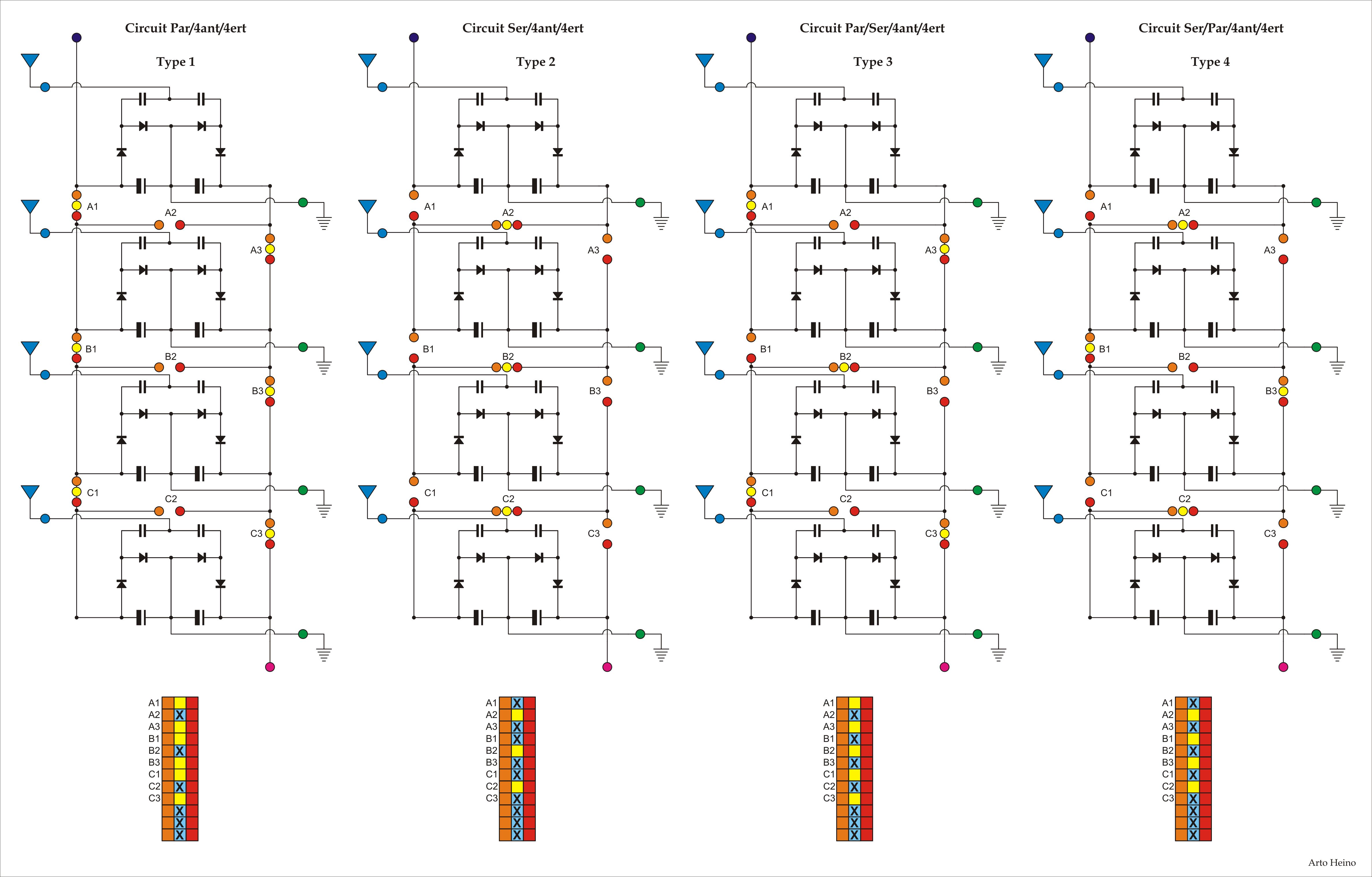
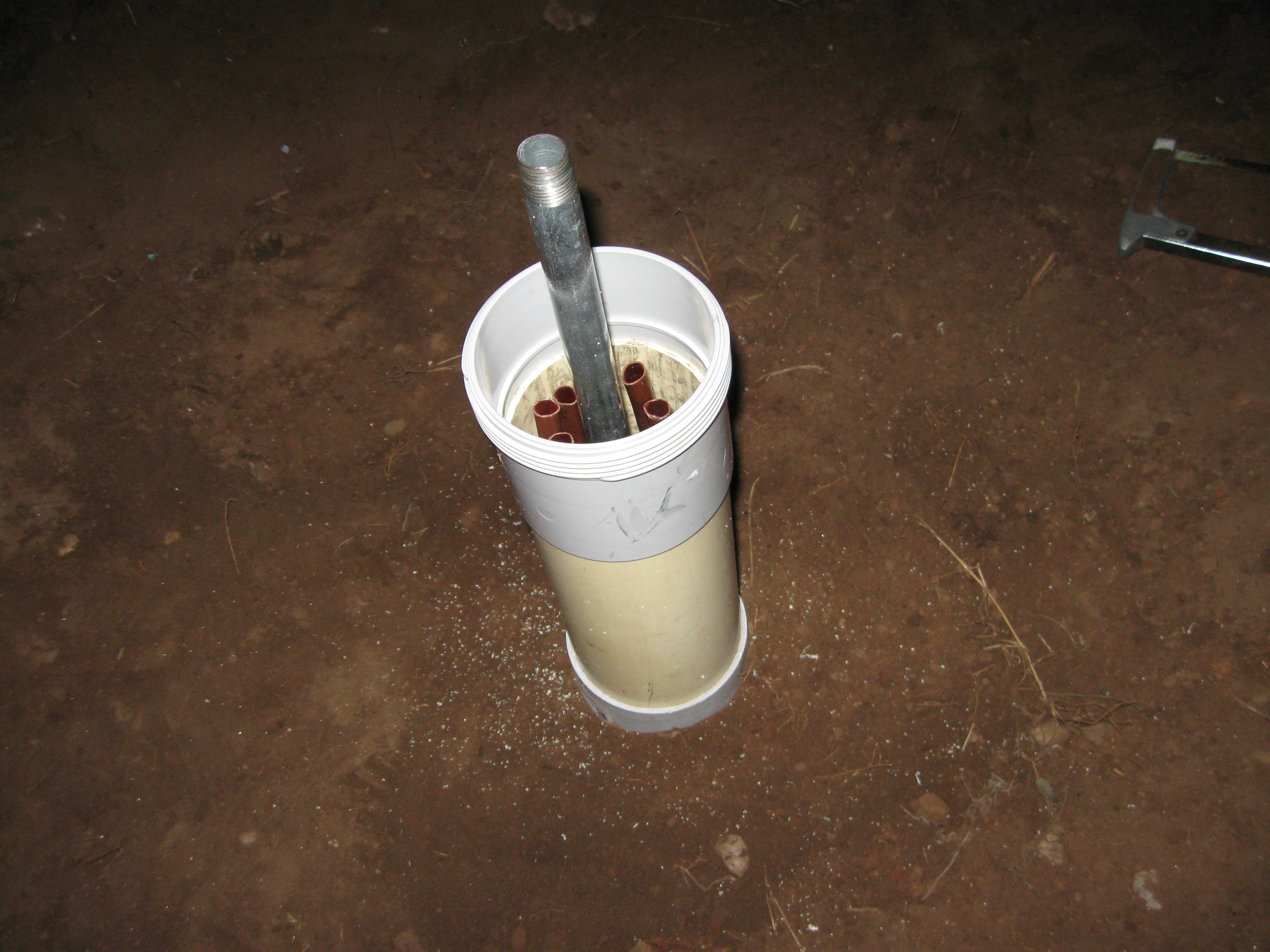
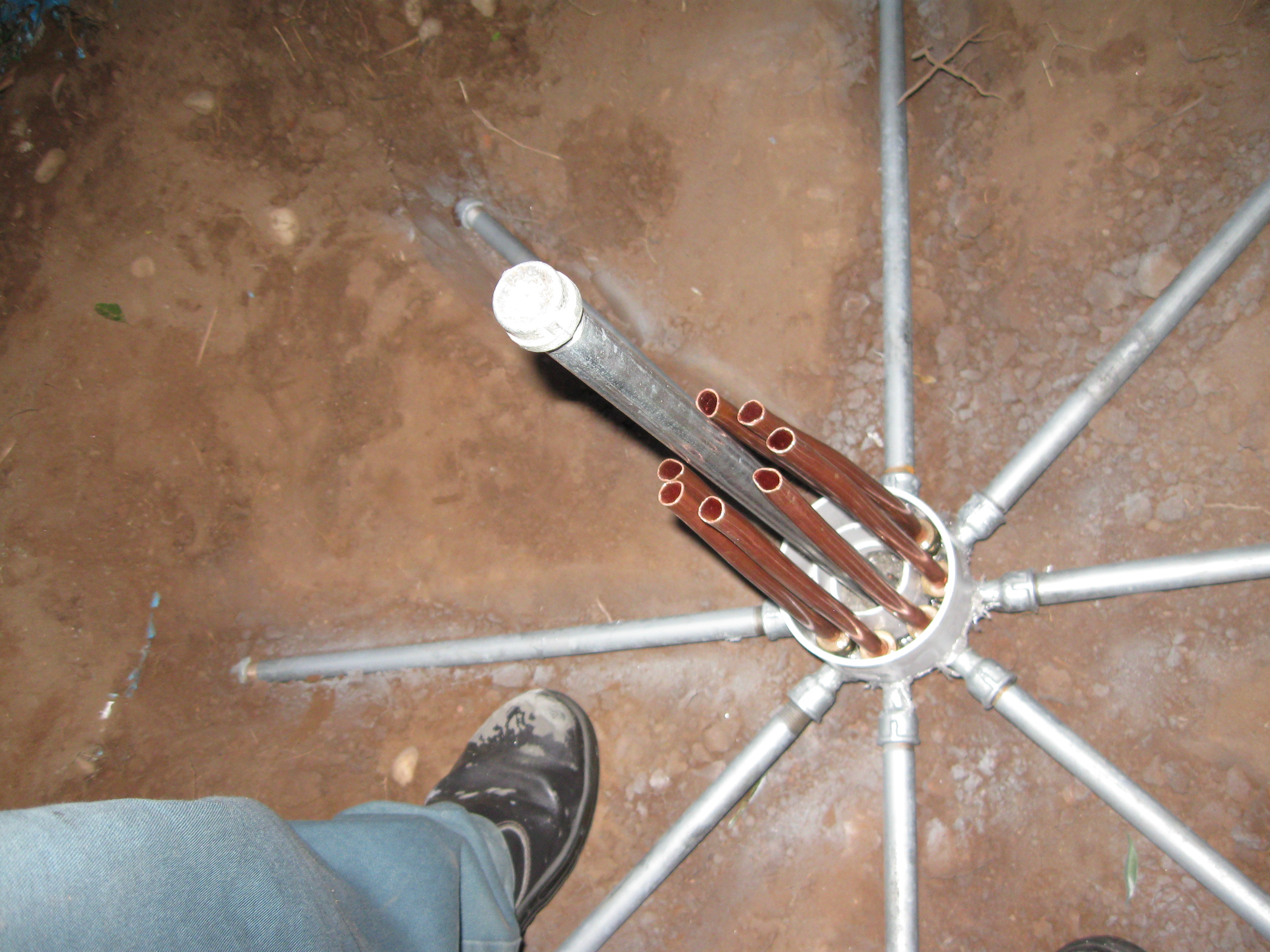
The key to getting the most from this system is to employ 4 separate aerials, each with different lengths and orientations. The other MOST important factor is the earthing that you employ, minimum would be a 1 mtr pipe into the ground, or a more elaborate version would be Picture E1 and E2 .

Many of the diodes that are usable
1N4148
1N914
1N34  ***** preferred – used in my system
1N60  ***

The smaller antenna caps – frequency dependent
10 pF
100 pf *** preferred
1 nF
10 nF
150 nf – used in my system
200 nf

The main storage Capacitors 12/16/25/35 V
1 UF
10 Uf **
100 Uf ***- used in my system
1000 Uf **
10000 Uf
Super Caps have been used successfully

The useful aerial wire lengths
10 mtrs 28 Mhz
20 mtrs 14 Mhz
40 mtrs 7 Mhz
80 mtrs 3.75 Mhz

As you can see by the measurements I have only used 3 types of arrangements

Type 1 = Serial = 1.58 volts DC
A – B – C – D

Type 2 = Parallel = 0.56 volts DC
A
B
C
D

Type 3 = Para / Serial = 0.59 volts DC
A   C
| – |
B   D

Type 4 = Serial/ Parr
A – B
|
C – D

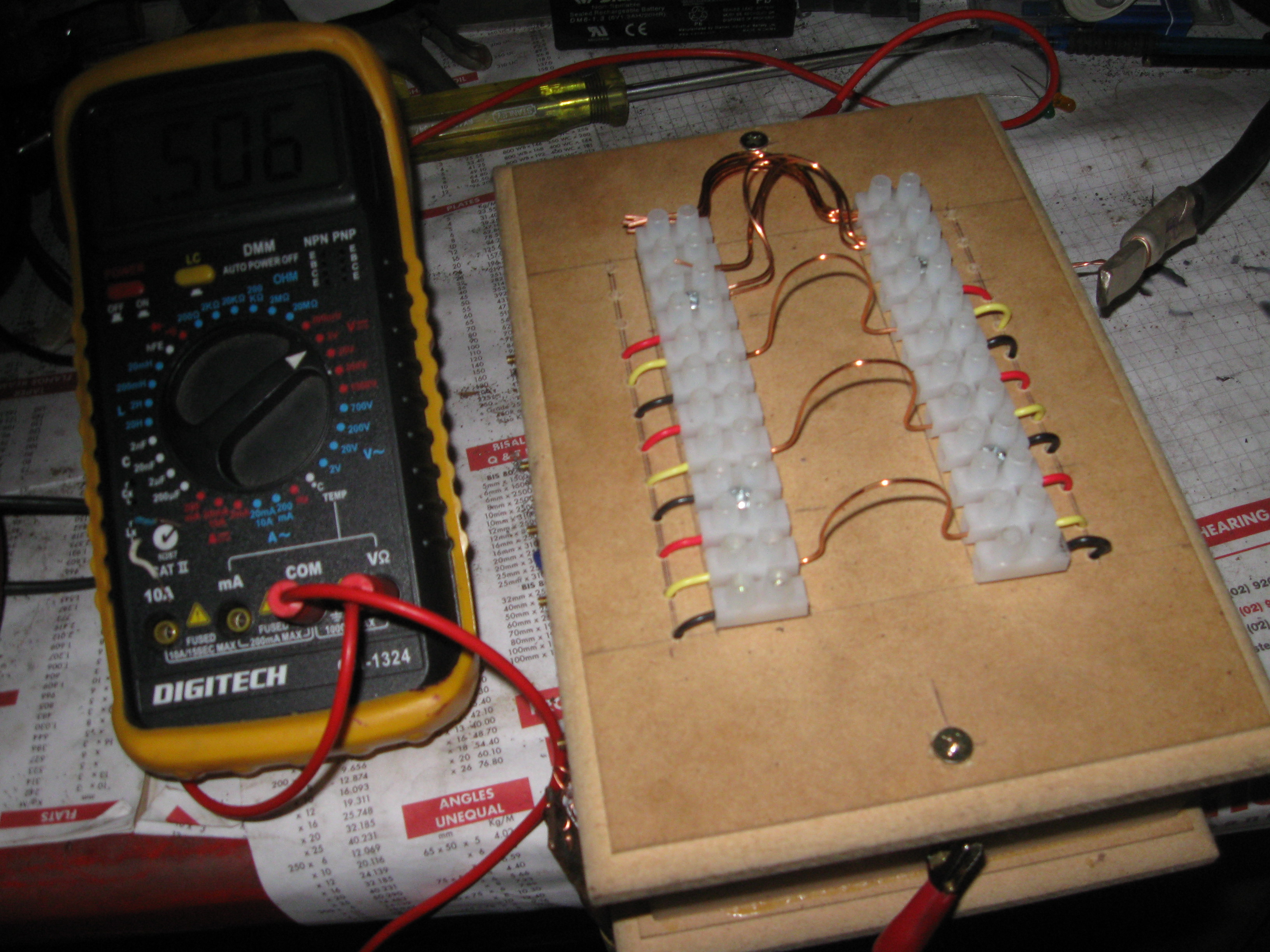
Here is some pics of some of my measurements.

Type 1 - 1.58v

Type 2 - 0.506 volts

Type 3 - 0.59 volts

Here is my earth connection.

Earth Connection

Earth Connection

Earth Connection

Earth Connection


The Tesla Wireless Power Transeiver

March 6, 2013

The mistakes of understanding the resonant Tesla Transformer has led a lot of engineers into adopting the very equations that deny a workable transmission system. If you build a Tesla coil that creates big sparks, then have only understood a system for spark creation, if you have built it and there is no spark then you have either failed or succeeded in your attempt. This is the conundrum of a true Tesla system, the correctly sized top load will balance out the resonant system and the high voltage transform will not leak and become transformed back into high current by the balanced reactances. The act of the resonance will be dampen by the resistances in the system, only by adding a little more power per cycle you have a continuous resonant structure, which is the heart of a good Tesla Transformer system.

To create large sparks you must allow the streamers to escape, to do this it is essential to do two things first make a sharp breakout point, secondly you must lower the top load capacity gradually until your goal is achieved. However this is not the purpose of a Telsa Transmission system, it is the opposite of sparking, a good system will not have any breakout points, you must maintain a contained and smooth voltage gradient on the surface of your capacitor.

Power factor correction is the term used by all electrical engineers, to Nikola Tesla this was just a normal part of the his system to allow maximum power flow and not have a voltage and amperage out of phase condition, good power flow requires a 90 degree lag and lead situation. This was ok in the first part of a Tesla coil system, Mains step up transformer for the first 2 coils in the ratio of 1:50 = 240-12000, then the high voltage Tesla transformer coils in the ratio of 1:20 = 12000-240000, added magnifier coil 1:4 = 240000-960000 volts. If at each step you ensure a least resistance and the electrostaticaly contained condition is maintained you can guarantee good results. Some of the conditions that need to be met are as follows;

1. No sharp points to cause ionizing
2. Large curvature of surface conductors
3. No large objects nearby to cause inductive capacitive effects
4. Well insulated lead in conductors
5. Magnetically shielded switching system
6. Well sealed and mounted components

I have been working on a number of coil systems over the years, success is always proceeded by learning curves that are the essence of discovery. Much work can be saved by a small number of calculations, guess work is not a road for designers of electronics, this doesn’t mean you cannot experiment on unknown arrangements, its just that your components can only handle what their designed for or you will cook and blow a lot of your hard work away.

I am releasing my basic design of my Tesla Power Transceiver System. The energy that is being transmitted and received is not the of the Electromagnetic Transverse wave variety so a lot of Radio theory stuff is not needed, the Magneto-dielectric Longitudinal wave is what is utilized. I have tested smaller designs with success and have no problem with its conception, I was aware of this type of wave back in the early 70’s when I was building radio circuits and making my own antennas. When I rediscovered Tesla in the 1980’s and found the work of Eric Dollard, I was happy in my understanding of these Longitudinal waves. As I am a musician, I had no trouble in knowing about longitudinal wave harmonics and its analogue in sound waves.

I have Included the two types of Velocity in the design, for success in this process you must utilize the Tesla Velocity wave as the Velocity of light only relates to the Electromagnetic wave. As you can see in all the parameters only the Primary capacitor and the Toroids are of different value when you use the Tesla Velocity wave. All the pipe sizes are standard PVC drain pipe and should be available, remember this is only a preliminarily draft design, not all the parameters have been analyzed for optimal use. Build at your own risk, more info in my book “Talking To The Birds”, now available at Amazon.com,  Good luck Regards Arto.

Complete Specifications of a Tesla Wireless Power Transceiver

Complete Specifications of a Tesla Wireless Power Transceiver

TeslaTowerSaq9

The Adams Motor

September 13, 2012

In 1986 I was designing some unique colour-music art (Synesthesia) and looking at ways to put this into electronics using leds, lasers, cathode ray tubes or computer programs, this led me to designing a colour organ that was fully integrated with audio correlation to the harmonic contents of the sound as well. I decided to apply for a patent and went to the patent office to do a search for similar devices.

During the search I listed a few names and previous attempts, which went all the way back to 1890’s, while I was their I also looked for new developments in electric motors, this was the moment I found the Adams motor and noted the inventor was from New Zealand and he had patented his invention in 1969. I immediately concluded this simple design would be very efficient and unique as all the poles were of the same polarity, this was duly noted and I pressed on with other matters at the patent office. Amazingly enough I did end up the the Edison Electric offices where I explained the basic tenants and principles of this colour-organ to a few very attentive engineers.  Later in that month I met with one of the patent holders for one of the colour-organs who just happen to be an artist as well and lived in Sydney.  Before the month was out I wrote to the Sharp corporation and presented my findings and possible applications on my invention, they wrote back to me with a generous tone and kept me in mind for any future developments in this direction.

A brief description of my colour organ – Frequency correlated harmonic fourier separation to colour chroma addition translated to voltage steps controlling electron charge amplifiers  creating a proportional light intensity and equated colour area and location in the visual field, the resultant beam or electric display (Tesla coils with or without  gas enveloped top loads, closed electron tube/ phosphor display, optical wall/3D display, Holographic multi- projectors, laser projectors) would modulate with sensitive modes that equated to the overall mood and flowing structure of the music based on translating electronics. Some of these ideas have been used by others in recent years, due to the advent of readily available electronic component modules.

This chance study of the Adams motor at the patent office was originally prompted by a childhood dream of a free running motor that collected the energy from the universe to power it. This reoccurring dream was in the late 60’s when I was building crystal radio’s, high voltage coils, transistor circuits and single valve circuits.  This was the time I listened to Short and Long wave radio with my home made aerials picking up whistlers and other radio noise that I found by pointing my wire dishes at different portions of the sky and at different times of the day and night. I was about 12 at the time when a lot of these ideas about how these things operated occurred to me.

In early 1990’s I started compiling my various work on many subjects including motor design, when I was pleasantly surprised that Robert Adams published a ground breaking article in the Nexus magazine on his motor design. This was an exiting time as a lot of the backyard and professional engineers were collaborating and working on many new devices. At this time in Sydney there were group meetings and we were showing our current builds and exchanging information between members, the only problem was the new paradigm of over-unity engineering was not developed enough to handle the questions many members had. As always, I was the outsider who didn’t put faith in the current techno-babble of electrical engineering, being self taught in these matters, I relied on basic tenants of creating the equations from the evidence, not forcing the build to comply with the equations. This is what I gleaned from most of  the Scientists and Inventors of history mainly  Leonardo Da Vinci, Nicola Tesla and Victor Schauberger. In a desperate attempt to help my fellow builders I met with Robert Adams at the Sydney Nexus conference, from that moment on I  corresponded with Mr Adams a few times and sent him a few of my design sketches. I will include a copy of one of the letters I received from him, below.

Letter from Robert Adams to Arto Heino

The testing process of my build of the Adams motor was arduous and drawn out over a least 2-3 years, I had to learn many new skills and I developed an intuitive insight into this simple motor that goes beyond equations and engineering. The great help came from the generous group I was involved with at the time, I was loaned a oscilloscope, that is when the next phase of my journey began. I tried to convey the results to my fellow researchers and found they were closed minded about developing new equations that included open systems, I met with many and explained the tenants of true free energy, they turned to their university books and denounced anything that was not written in the science bibles. As I was not brainwashed in these matters, I could see their distress when I confronted their most hallowed beliefs of the system of modern science they were taught as sacrosanct, alas Einstein ruled. I am not a scientist or an engineer, I am an Artist from the school(mind set) of  Leonardo da Vinci and Walter Russel , therefore I am a natural scientist and observer of phenomenon, please allow me at least this modesty for my years of study and practical application .

I moved away from trying to convince others of the errors hidden in the equations and I allowed the natural curiosity and time for them to realize and discover it in there own time, the greatest teacher is ones own experience. This has been the legacy of Robert Adams, a man who spent a lifetime serving the system only to confront it head-on with its own  fallacies. Robert had been attacked on many occasions by the agents of a flawed science, only to be praised by those who have already awakened to the same dilemma  such as the notable scientist Harold Aspen. Their written legacy still exists for other to learn from.

I will not include in this blog the 400 odd tests that I performed as this would prove nothing, the tests were for me to understand the operations of the motor circuitry and look for environmental correlations. I have seen many people approach the design of the Adams motor with a sledge hammer, with stronger magnets, faster speeds, larger disks, bigger coils etc, this has always been to no avail as the basic understanding has been missed. This motor will run in a resonant fashion, to itself and the environment. This is the key, do not underestimate what Robert Adams tried to convey with his descriptions and explanations. Look at the  wave functions  of the whole solar system, day/night,  altitude,  atmospherics, terrulian currents, temperature, EM fog and geographic location before you make conclusions about how this simple motor operates. Energy is everywhere, tapping into this resource takes patience, observation, curiosity, creativity and sound scientific principles. Do not be led into a blind alley of dogmatic procedures that  avoid the hidden truth that we live in an OPEN system and energy is always available to be used through the correct gating mechanisms that we discover.

Here is a schematic of the Adams motor design as I have come to understand, I have not included all the equations required to build such a motor/gen, just the basic schematic I have revealed. The complete transcriptions and equations will be in my book “Talking to the Birds”, Regards Arto

The Adams Motor

The Adams Motor


Multi-Filar Coils

August 24, 2012

While making observations of coil designs that have been used over the centuries, I noticed only those that showed some perceived useful results were kept in the arsenal of the scientists, the rest were either ignored or forgotten. There are two basic types and a 3rd being the combination:

1 Circular – Eg Solenoid, flat spiral,spherical, toroidal, mobius

2 Non-circular – Eg Basket weave, geometric, polyhedral, star forms, mobius

The circular types have 3 basic types  a resultant 4th and the unique 5th type:

1 Rings adding vertically –  Solenoid Coil

2 Rings expanding diametrically  – Flat spiral

3 Rings adding in a circular form – Toroidal

4 Rings adding vertically and/or diametrically and/or circular

a) Conical – differing sizes in both direction

b) Multilayer Solenoid – same sizes vertically + differing sizes diametrically

c) Multilayer Flat Spiral – same coils sizes vertically + adding vertically

d) Toroidal and Poloidal windings mixed sizes vertically + differing sizes diametrically

e) Spherical rotations windings mixed sizes radially + differing sizes diametrically

5 Winding folding into itself, creating a single surface  – all possible geometries – Mobuis

The shapes of coils are one aspect the other is the winding order and direction, thus creating multiple poles, cross coupling inductance, retarding or increasing both the inductance and the capacitance as the design requires, the addition of the mobius windings diversifies the basic options, this is where the art is at in 2012. A good example of combining many geometries and winding types is the:

Magnetic coil(1820 Hans Christian Oersted)

Faraday coil(1831 Micheal Faraday)

Henry coil(1831 Joesph Henry)

Induction coil(1836 Nickolas Callan)

Ruhmkorff coil(1851 Heinrich Ruhmkorff)

Helmholtz coil(1869 Herman von Helmholtz)

Maxwell coil(1873 James Maxwell)

Cook coil(1871 Daniel Cook)

Tesla coil 1/4 wave(1891 Nicola Tesla)

Tesla Flat coil(1890 Nicola Tesla)

Tesla Bifilar coil(1894 Nicola Tesla)

Hubbard coil(1918 Alfred Hubbard)

O’Leary Coil(1920 William O’Leary)

Hendershot coil(1928 Lester Hendershot)

Interceptor coil(1946 John Wiegand)

Tokamak coil(1950 Oleg Lavrentiev)

Stellartator coil(1950 Lyman Spitzer)

Smith coil(1952 Wilber Smith)

Fusor coil(1964 Philo Farnsworth)

Hooper coil(1968 William Hooper)

Rodin coil(1986 Marco Rodin)

Biaxial Poloid coil(1990 Bo Atkinson)

Tetra Helix coil(1991 Bo Atkinson)

Vortex coil(1992 Ken Gailey)

Double Helix coil(TM) (2007 AML)

Not to mention my own explorations in coil geometry with:

Mandela coil(1990 Arto Heino) – Page 55 – Link

Crown coil(1994/2011 Arto Heino) – Link

Infinty coil(1993/2011 Arto Heino) – Link

– and many toroidal/polyhedral mixtures that have been popping up regularly with names like the Star ship coil, Loohan coil, Polish coil,  Big Secret coil, some of these are marvels of artistry and human innovation.

Not to mention the many non inductive windings that are used as resistances. This has been looked at for at least 200 years, Nicola Tesla was one engineer/Scientist who’s original thinking left a legacy of numerous winding geometries he used to design his motors and coils,one of these is his Bifilar design. This design exposed a unique addition to the idea of combining the merits of both coil and capacitor without addition hardware contrivances, the anti-series winding nulls out self-inductance.

Nicola Tesla writes that a standard coil of 1000 turns with a potential of 100 volts across it will have a difference of 0.1 volt between turns.
100/1000 = 0.1
A similar bifilar coil will have a potential of 50 volts between turns.
100/2 = 50
In that the stored energy is a function of the square of the voltages, the ratio of energy in the bifilar to a standard coil will be
50^2/0.1^2 = 2500/0.01 = 250000
Which as stated by Tesla, “the energy stored is 250000 times greater than the standard coil!”

The storage of energy when pulsing a bifilar coil is n amount more than a standard solenoid/flat coil, as Tesla stated and gave you the formula to engineer this type of coil, we should be incorporating this simple idea into many everyday devices. I have drawn a few design methodologies that I hope will spur this well known innovation into more interesting directions.

These are basic bifilar solenoid configuration showing the capacitance between each winding. The windings can be rearranged in a different order to change the amount of induction and capacitance you put into the coil.  The winding below shows what can be done to rearrange the capacitive differential to increase the energy storage.
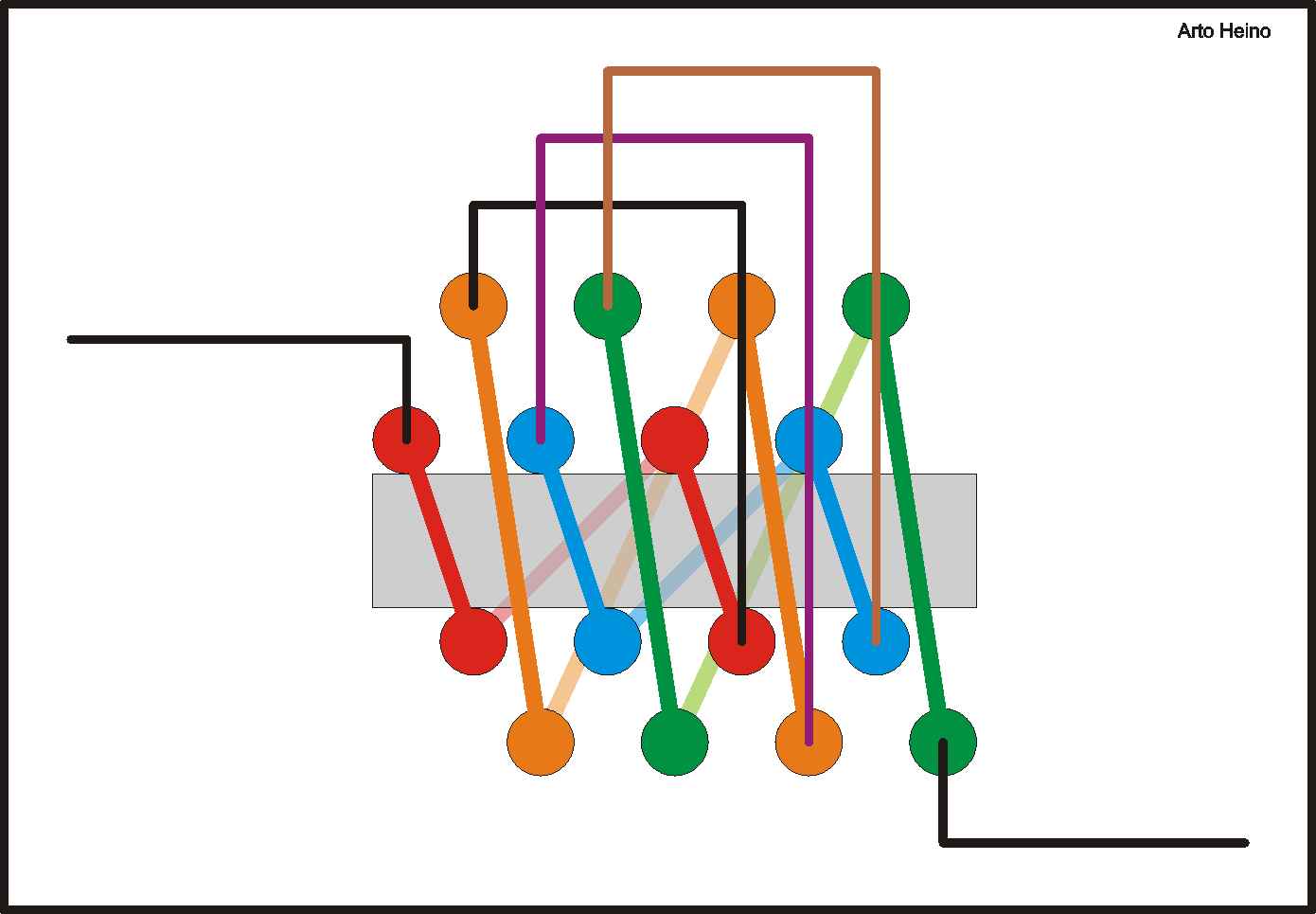
The graphic table below shows how many different arrangements that can be used with a Quadrifilar coil system, each will give a different result for the inductance, capacitance and its resonant frequency spectrum.

A great science/engineering project or University paper for someone would be to tabulate and analyze  each arrangement,  you might just get your doctorate on this.

The flat coil is a dimension less than the solenoid and a lot easier to redefine into  multi-filar arrangements.

The basic geometries involved in designing coils, transformers and bifilar systems must have a few design rules so the engineering of these items become straight forward and adaptable to the needs of the energy transformations. Here are a few simple systems that can be easily expanded and used creatively.

The cipher I am using here is:

B = Blue              R = Red

U = Upper          L = Lower

N = North           S = South      / is the upper part of the cross

E = East               W = West       \ is the upper part of the cross

The order of the letters is the order from the top to the bottom.

The order of the numbers is from the left to the right.

The first set is based on 2 simple loops. This will give you 8 different forms:
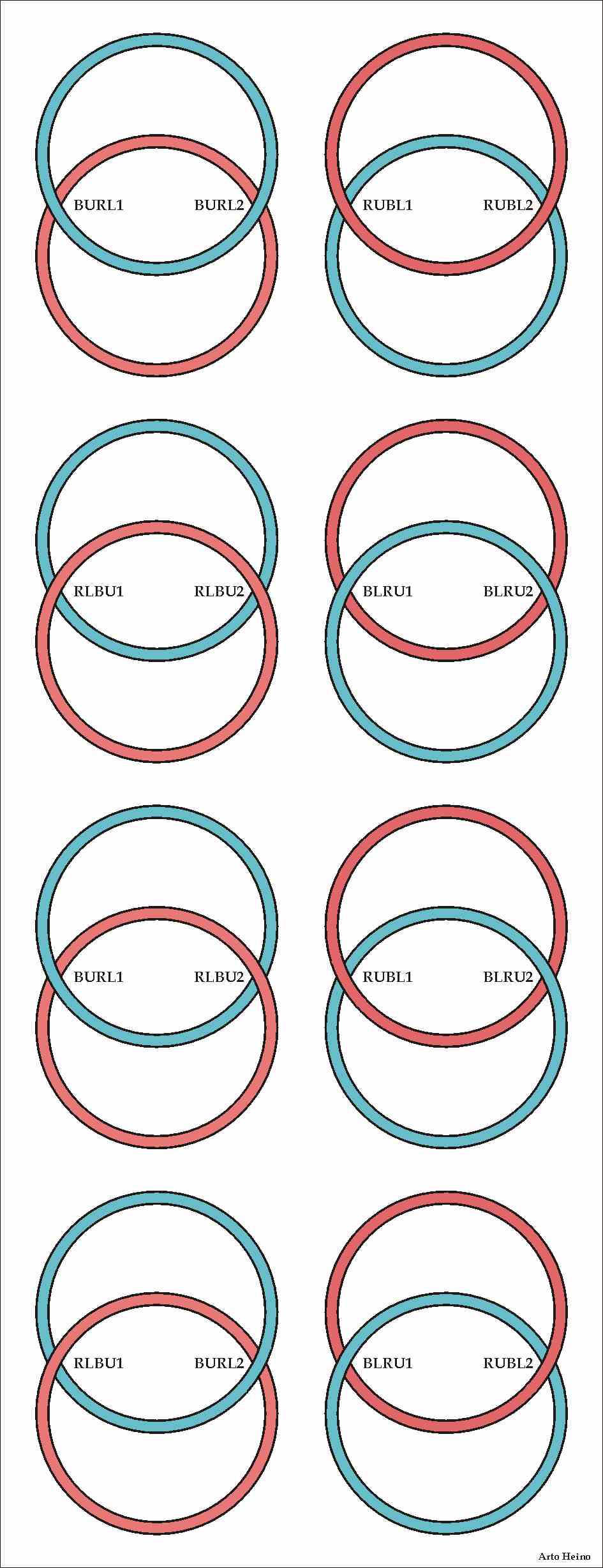
The next is the topology of a single loop of wire which loops on itself, like a bifilar or just a plain solenoid:

As you can see by these configurations, the standard engineering practice used in industry only use a small portion of these geometries. Now if you loop 2 coils as used in transformers you will see industry only apply 1 or 2 of these geometries in 98% of all transformers.

The fusing of  Adams motor and the Tesla bifilar coil was one of the first iterations that showed me the correctness of this approach by its exceptional efficiency.

Incorporating both bifilar and loop transformations as shown previously, you can begin to appreciate the transformations I have below to create a magic square coil, as originally shown on my Artoworld website in 1999.

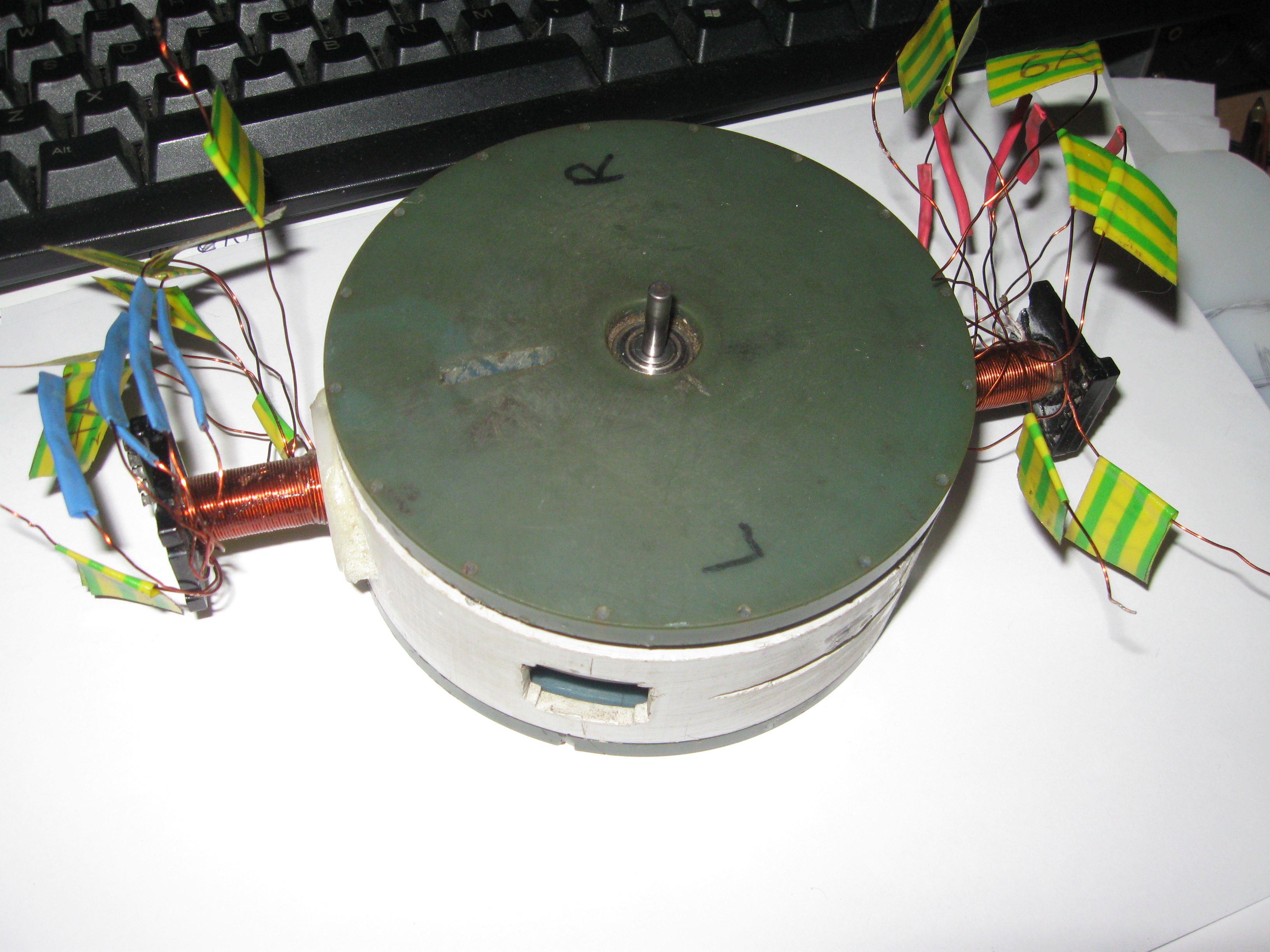
Old photo from 1999

Most of the original readers of these documents never understood my topology in 1999, even though I built many of these coil constructs as stators for pulsed motors. The current breed of experimenter has less inhibitions to these  geometric forms. The first arrangement is the non-magic numeric sequence, just the same as if you wrap a standard solenoid.
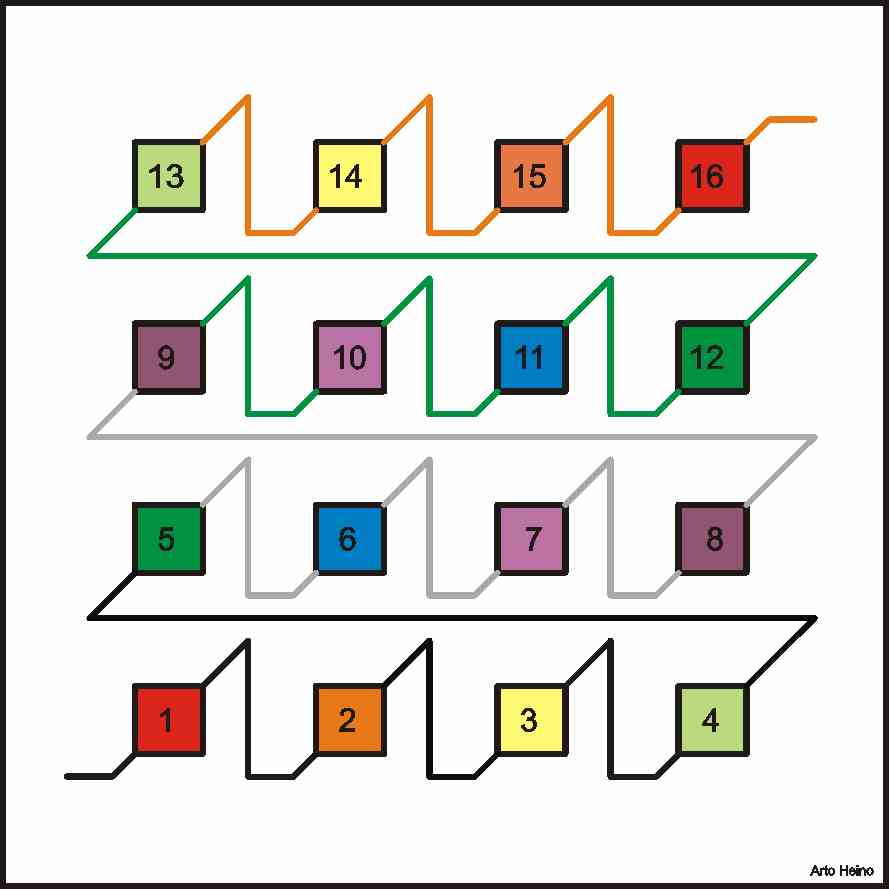
Colimag4

The next diagram is the magic square arrangement, which utilizes the the pairing of the “17” as a magic square paring which translates to the bifilar pairing.
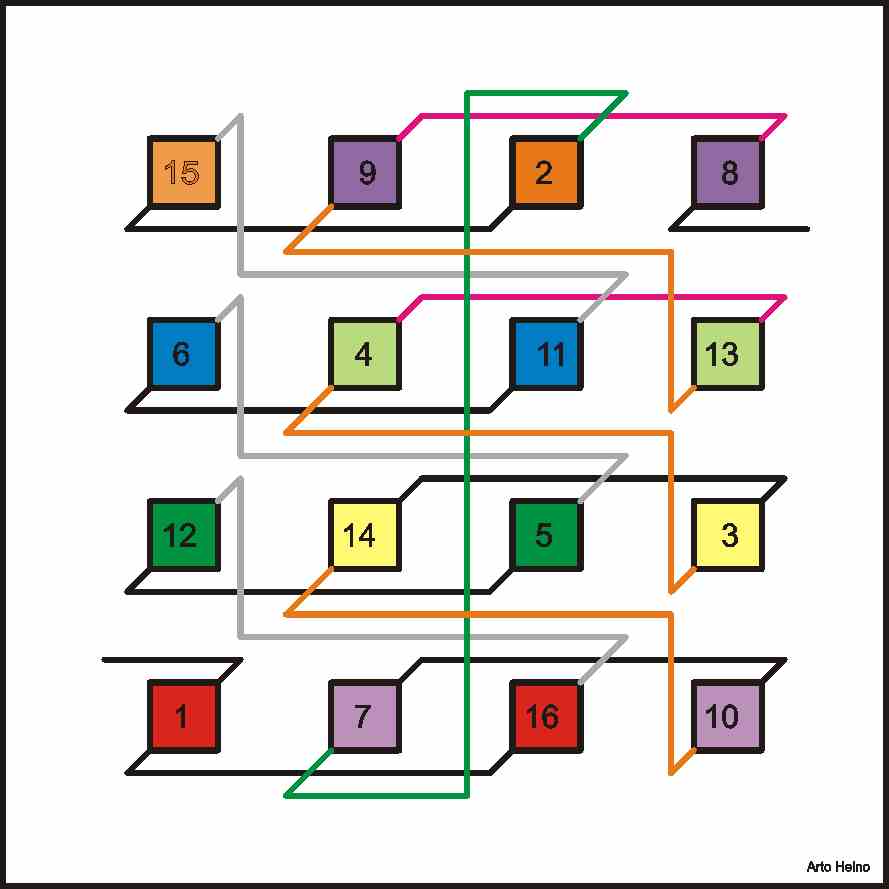
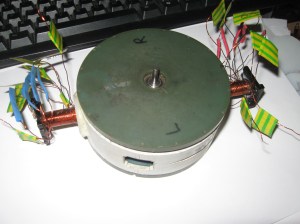
Below is the original stator coil I wound in 1999, it performed well and required high voltage(24v) and low current(0.001 amp).
I hope this small extract from my upcoming book “Talking with the Birds” will be helpful in any research you might be doing. Regards Arto

Here is  Link to a Multifilar Coil Manufacturer, called Custom Wire Technologies Inc. Give them a buzz they might help you, Regards Arto

https://customwiretech.com/

*** Update***

I have had a request to explain the Tesla/Adams Bifilar setup, here is a diagram that should make it transparent. The consequence of using this way of connecting coils will give you a multitude of possibilities for the experimenter to find interesting combinations ,  have fun regards Arto.
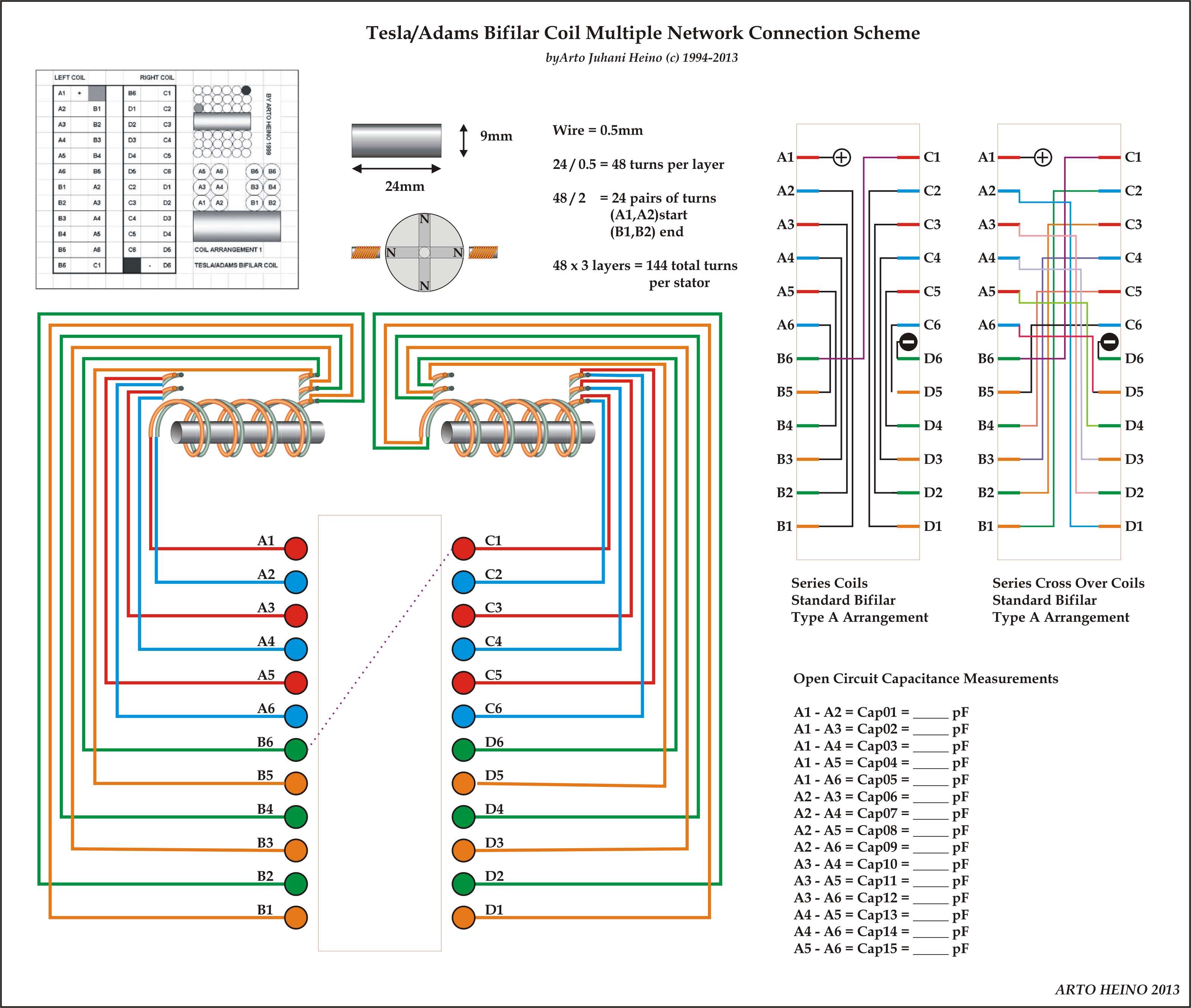
AdamsCoilsb2*** Update 2 *** 03-06-2013

Thanks to Andy I have added one more diagram to help decipher my Magic Square Coil arrangements.

AdamsCoilsc3

*** Update ***

Added the Spiral coil implementation.

AdamsCoilsd4For the continuation of this blog go to : https://artojh.wordpress.com/2013/06/05/magic-square-coil-technology/

Or buy my book at Amazon.com

One-Time
Monthly
Yearly

If you would like to help my efforts in all my future posts, I would very much appreciate your donation.

Make a monthly donation

Make a yearly donation

Choose an amount

¤5.00
¤15.00
¤100.00
¤5.00
¤15.00
¤100.00
¤5.00
¤15.00
¤100.00

Or enter a custom amount

¤

Your contribution is appreciated.

Your contribution is appreciated.

Your contribution is appreciated.

DonateDonate monthlyDonate yearly

The Infinity Coil

August 4, 2012

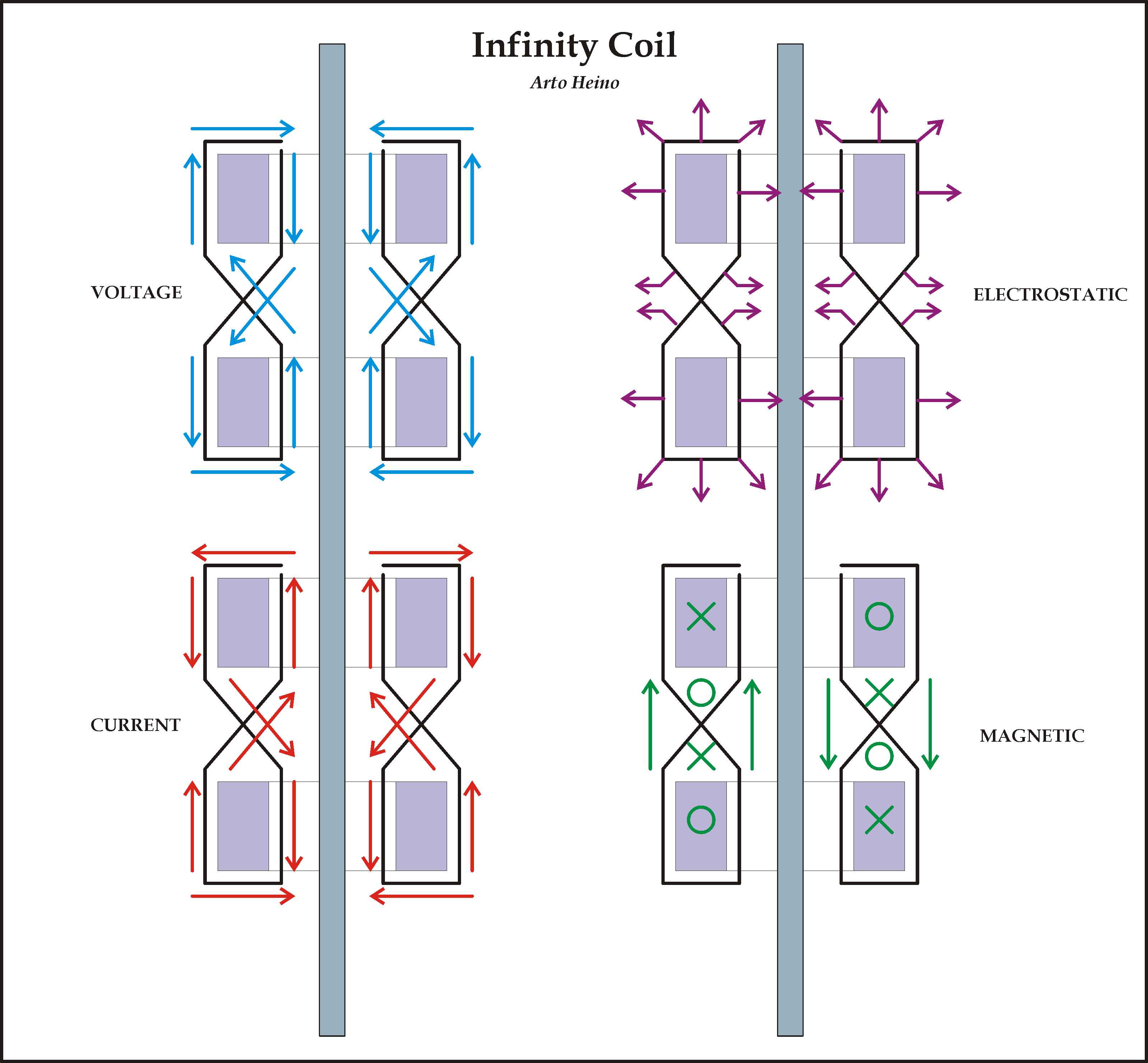
When I was working on the many forms of the Robert Adams motor in the 1990’s , I was happy to fulfill the basic tenants of the original Robert Adams design. The clear revelations of a simple switched reluctance motor with parametric amplification factors that can go into resonance with itself and the larger environment gave me inspiration in the form of a double coil in the figure eight with two rotors running in opposite directions and two sets of pulse coils.

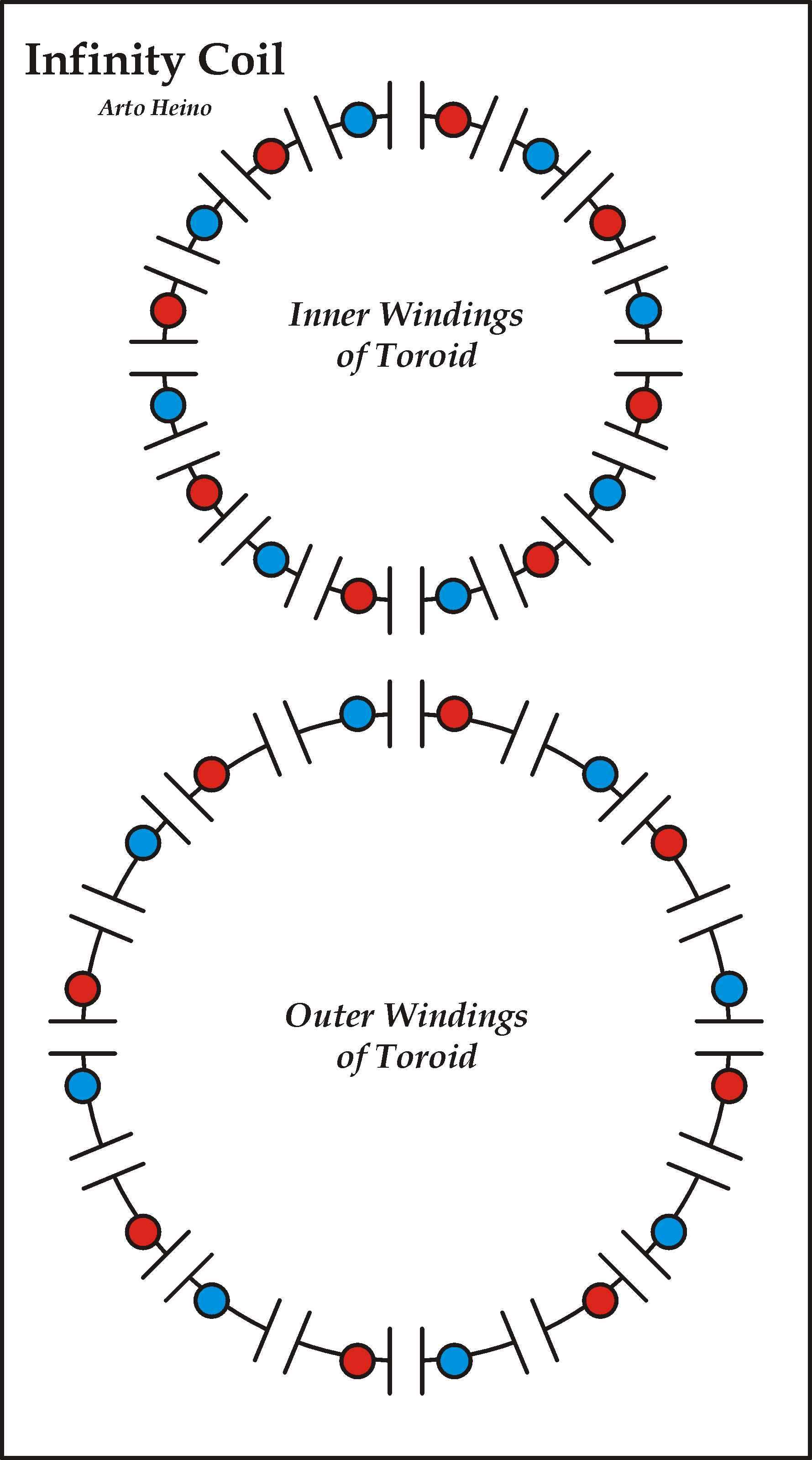
After many years I decided to return back to these designs as they merit greater experimentation. The original Infinity coils were two solenoids in parallel wound in a figure eight fashion, this would also work on two toroids stacked in parallel also adding the bifilar winding scheme, this became my final design as shown below.

As to the functionality of this coil, I put together a simple pulse circuit, that only uses a 0.5-3volt source and lights a MR16 3W light for about 10 hours beginning at 60% illumination, as shown below.

There is still more work that has been done on this arrangement as all relevant factors are notated in my up coming book ( “Talking with the Birds”) and have been explored to a greater degree than presented here. Regards Arto