Posts Tagged ‘technology’

Ternary Coded Decimal and 7 Segment Control.

March 23, 2024

When you are designing binary circuits you will need to display your results in Decimal so it readable by the user, such as Temperature, Distance and Arithmetic calculation results. There are 74LS chips that will make the conversion for you, such as the 74LS148. It seems like we need to investigate the Ternary version and see if reveals some interesting results.

1A

The first design (1A) utilises the well known Ternary TAND Gate, where the assertions are the positive voltage only.

1B

The second design (1B) replaces the TAND with a TONLY Gate as we have no need of the negative values if we are interfacing a binary circuit. Looking at the TONLY Gate it seems that we do not need such a complex gate as the ones used, maybe we could just use some Unary Gates to do the same job.

1C

Design (1C) fulfils this completely using only 3 Unary gates, by creating a USR Gate that can be modified by another input, in this case it is the positive that gets asserted from the result of the first input, the final Gate is just another cascade from the second Gate. The output is either positive or zero so it can be linked to a Binary circuit.

1D

The last design (1D) in this set reduces the Unary Gates to 2, thus allowing a negative as an output, this is mainly for use in other Ternary circuits, like the one I will show in another design (2B).

My basic approach to using Ternary, is to make it more useful than binary which has many short falls that nobody can see unless you have been involved in designing these circuits from scratch, the current pardigm requires a complex binary arch to acomplish results and requiring multiple iterations to arrive at a result. Where Ternary can accomplish more in less gate interations than binary. Each Ternary Gate is only slightly more complex than its Binary counterpart, such as the inverter.

These circuits show how much can be achieved with less resources while being less complex connections than the binary version.

7 Segment Circuit

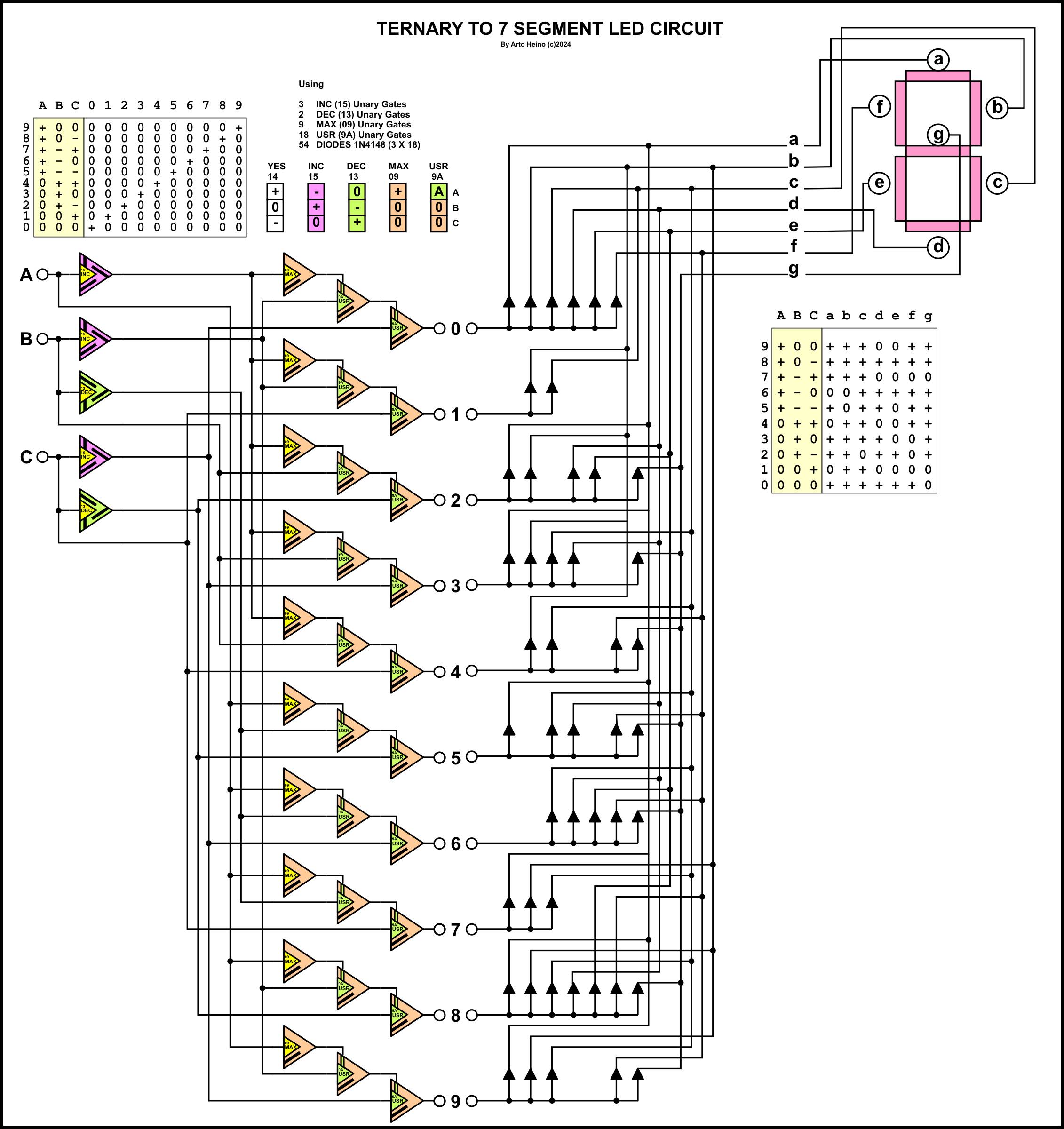
The final section is the Ternary to 7 Segment circuit. The first circuit (2A) is a basic 0 to 9 Led from a 3 Trit input, using the 3 Unary Gate logic from my earlier design (1C), the second circuit (2B) gives you another 9 more selections. Ternary easily uses negative numbers to increase data width selection, more elaborate schemes could be accomplished, like a complete 27 symbol choice, if I used all 13 positive numbers and all 13 negative numbers and zero.

2A
2B

Both of these designs use Diodes to accomplish the 7 Segment interface, making it suitable for a LED chip such as a Common Cathode TOS5121AR (Titan), LSD505400 (PlusOPTO), LTS-5003AWC (LITEON). You could even make your own with Leds or use a Large display.

I hope to finish my Division section of my Ternary ALU very soon, so far I have Addition, Subtraction, Multiply and a few Logic gates. I am still designing the shift registers and memory, while the ROM will be programmable with switches, I am basing it on 81 Trits at present.

Regards Arto
Quad Radiation Converter

March 15, 2013

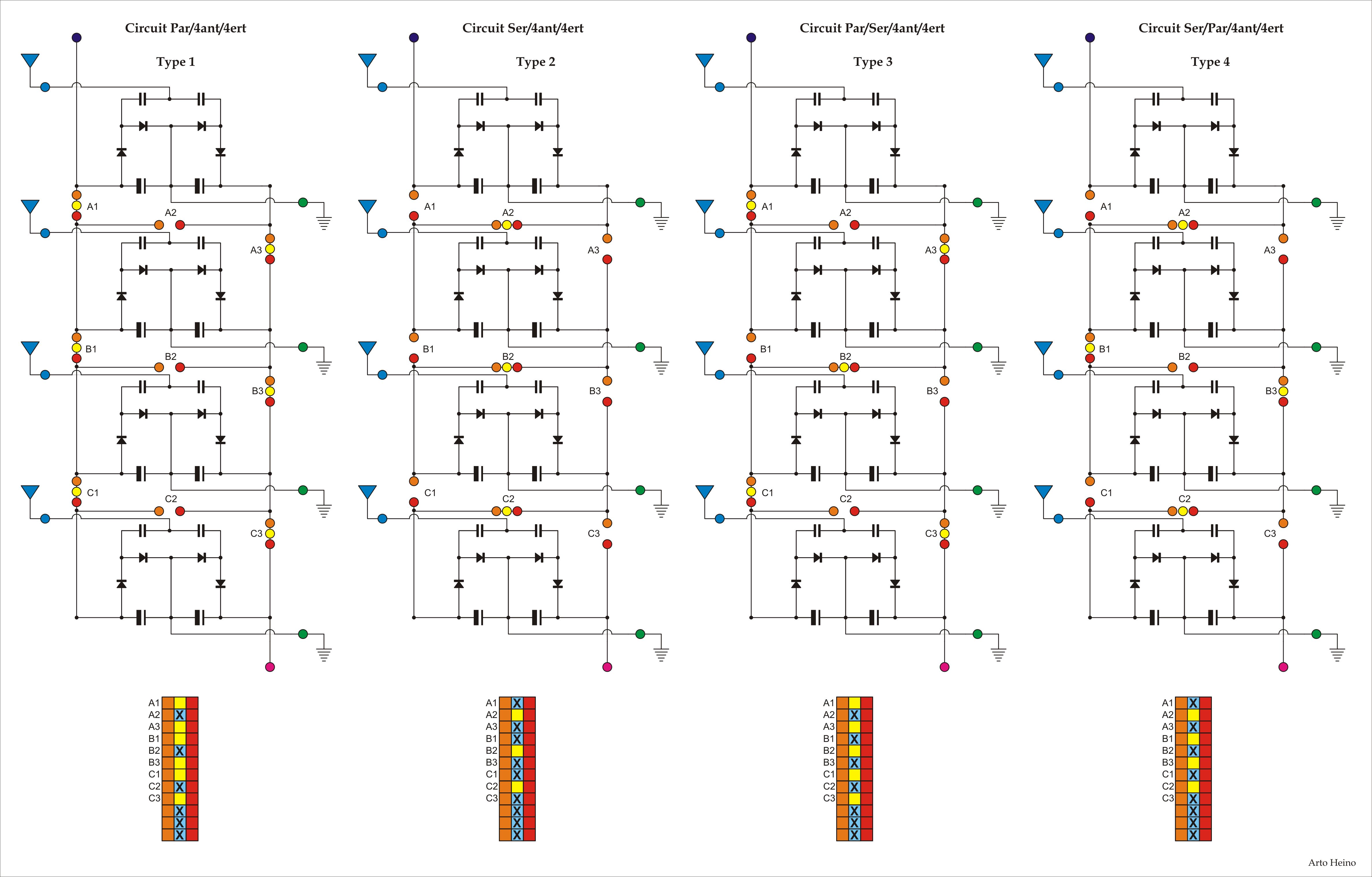
Here is a fun project that will give you about 0.5/0.6/1.58 volts of radiation energy reception. The analogy is like a putting a microphone in a noisey environment and converting the noise into energy, either to recharge a battery or light a led. Some people call this a free energy receiver and they would be wrong in that assuption as the cost was in the original source radiation.

QuadRadio5

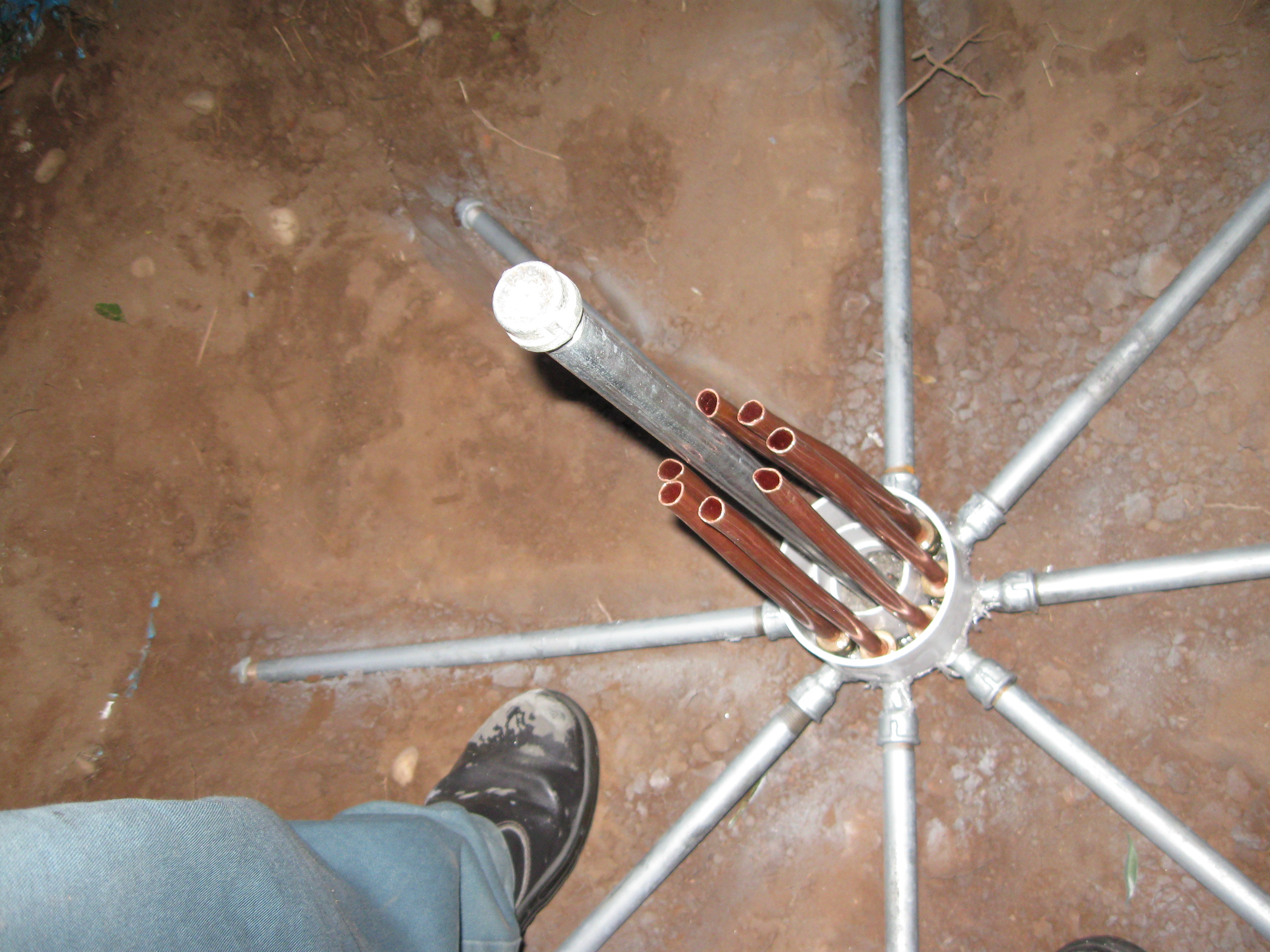
The key to getting the most from this system is to employ 4 separate aerials, each with different lengths and orientations. The other MOST important factor is the earthing that you employ, minimum would be a 1 mtr pipe into the ground, or a more elaborate version would be Picture E1 and E2 .

Many of the diodes that are usable
1N4148
1N914
1N34  ***** preferred – used in my system
1N60  ***

The smaller antenna caps – frequency dependent
10 pF
100 pf *** preferred
1 nF
10 nF
150 nf – used in my system
200 nf

The main storage Capacitors 12/16/25/35 V
1 UF
10 Uf **
100 Uf ***- used in my system
1000 Uf **
10000 Uf
Super Caps have been used successfully

The useful aerial wire lengths
10 mtrs 28 Mhz
20 mtrs 14 Mhz
40 mtrs 7 Mhz
80 mtrs 3.75 Mhz

As you can see by the measurements I have only used 3 types of arrangements

Type 1 = Serial = 1.58 volts DC
A – B – C – D

Type 2 = Parallel = 0.56 volts DC
A
B
C
D

Type 3 = Para / Serial = 0.59 volts DC
A   C
| – |
B   D

Type 4 = Serial/ Parr
A – B
|
C – D

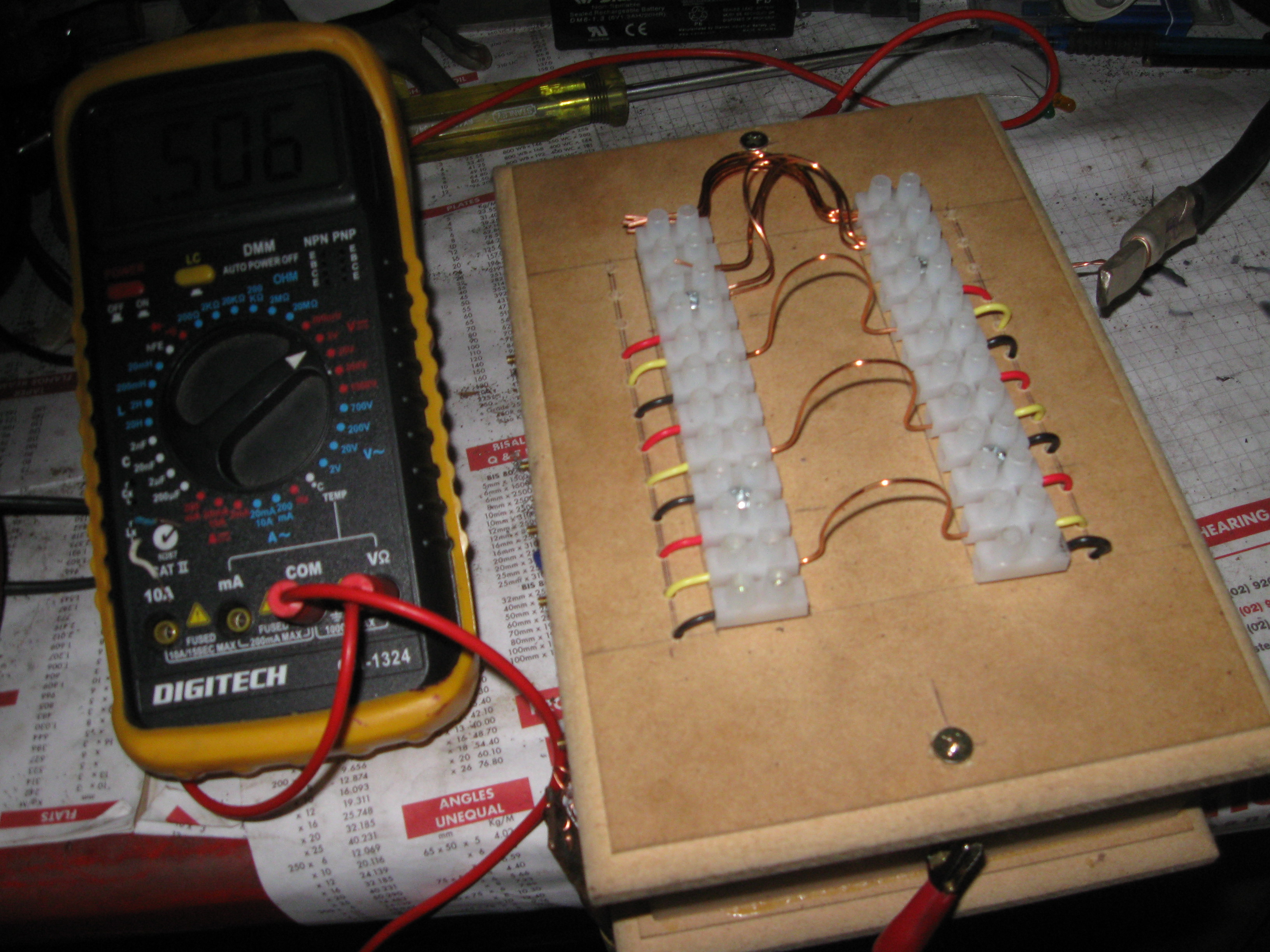
Here is some pics of some of my measurements.

Type 1 - 1.58v

Type 2 - 0.506 volts

Type 3 - 0.59 volts

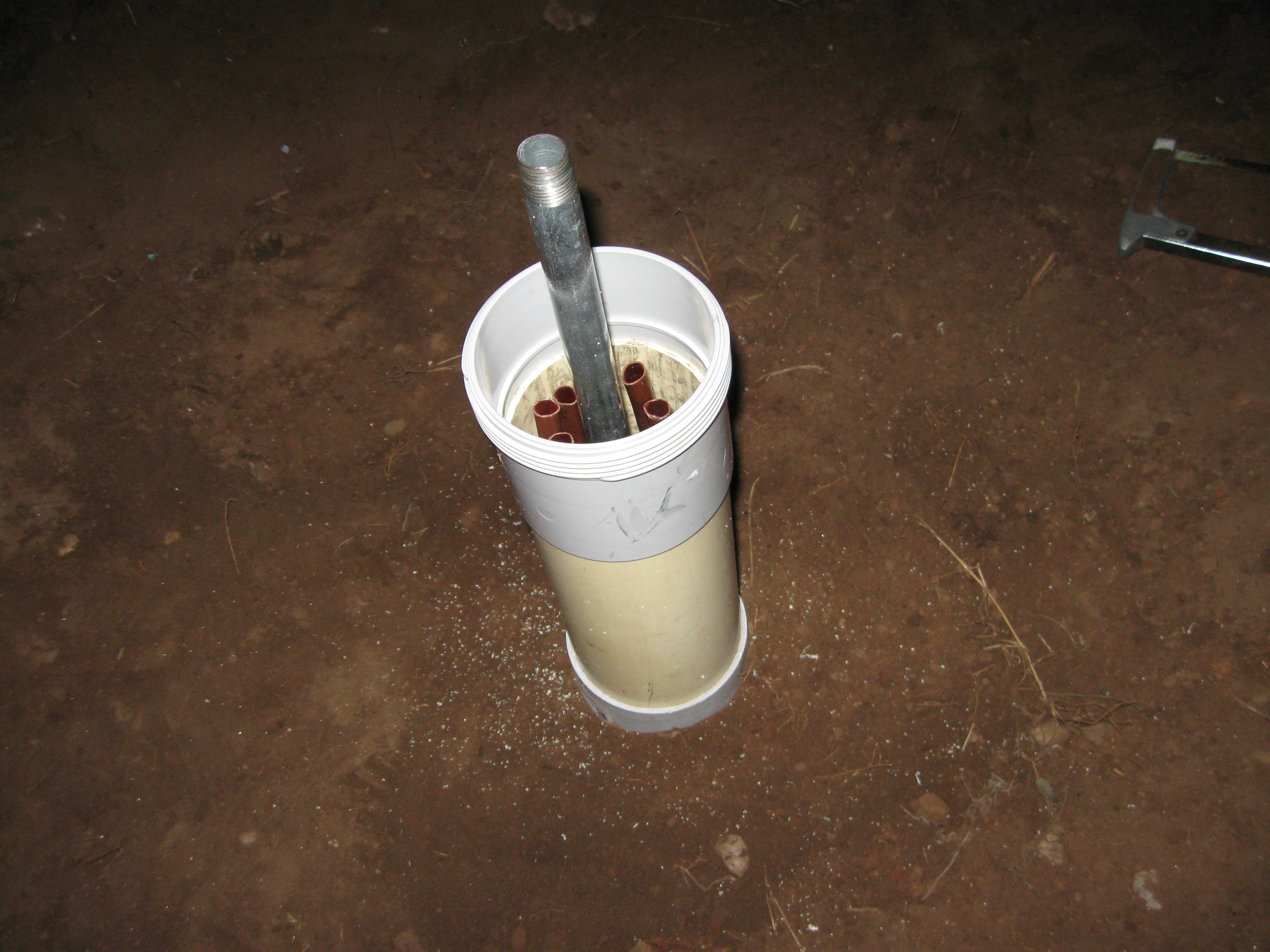
Here is my earth connection.

Earth Connection

Earth Connection

Earth Connection

Earth Connection


Thornson Drive

September 23, 2012

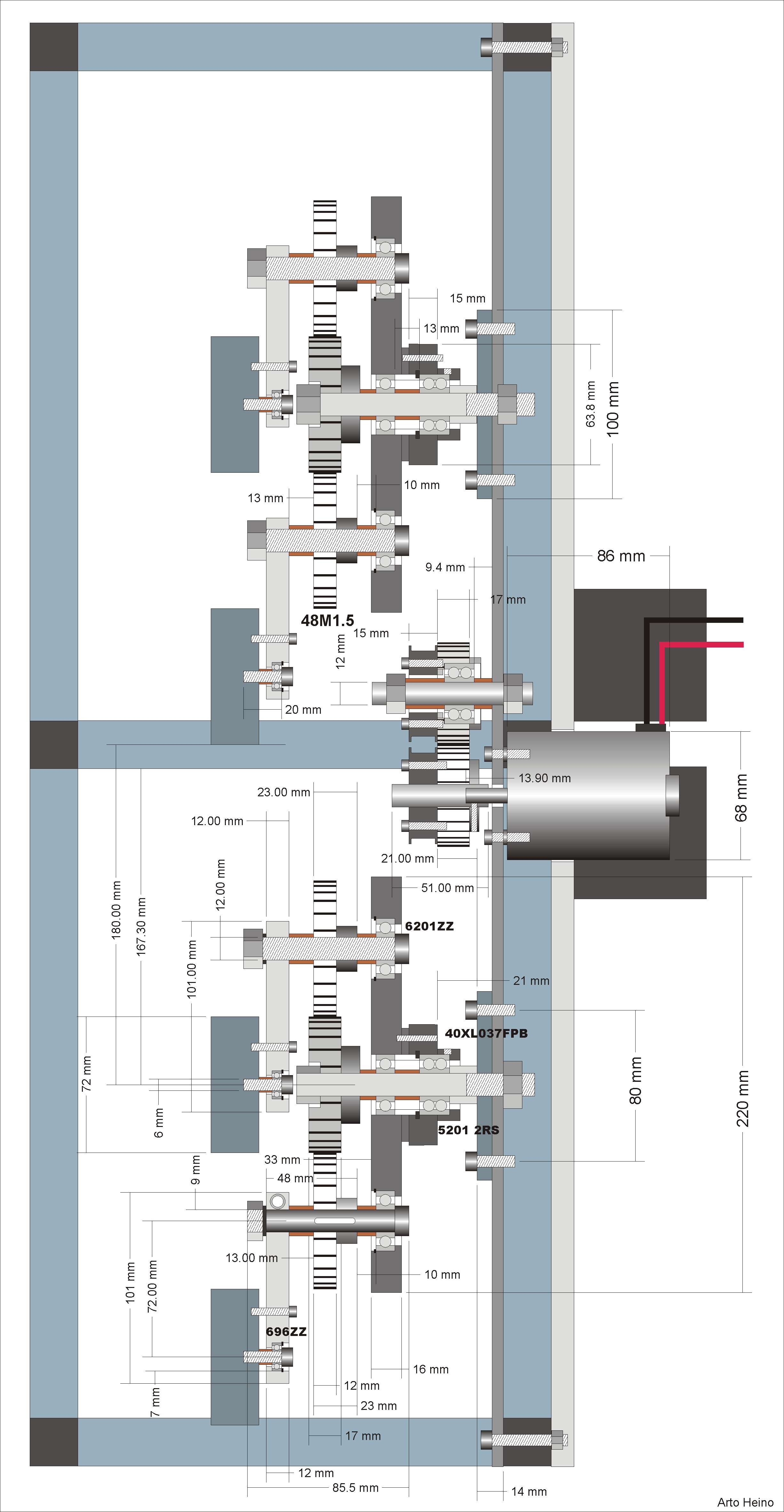
In 2006 I decided to build an inertial thruster, I chose Roy Thornson’s  design, as his seemed to be the most straight forward system. The science behind an inertial thruster has been explored by many scientists, engineers and inventors who have been awarded patents for the functional proof with a working model. The secrets behind this sort of device is in the translation of gyroscopic inertia and rotational geometry, I have been tentatively working on the complete engineering maths required to build usable designs that can replace standard gearbox/universal/differential shafts and gear transmission components. This task is daunting, still if nobody tries I am sure it will be lost to history and we will again be set back in mankind’s quest to free himself of the foibles of  Newtons mechanistic 17 century engineering.

I have designed a lot of these types of inertial systems for years , I never got around to building one,  so I thought I would start this journey by testing Roys design. I built almost all of it before I ran out of money, now it sits here begging me to finish it. I tested the half that I completed, it had extremely powerful pulsations at the vector force differential direction that it was designed for, because I only have half of the machine finished it was imbalanced, man.. it almost took my arm off.

I am only including this in my blog to show how to build this device. If I could get some funding for my time, the remaining parts and machining I would like to finish it and put it on public show. Email me if you are interested in helping me complete Roys inertial thruster unit. I will expand this post with more details if I get some positive responses from my readers, regards Arto.

This work here will be in my second volume of “Talking to the Birds”, the first volume is available now.